
Bong! Bong! It’s midnight on New Year’s Eve at a Buddhist Temple in Japan.
The toll of the Temple bell rings out one hundred and eight times; the tolls representing the number of ‘earthly desires’ (such as anger, jealousy and avarice) which plague mankind, and stand in the way him reaching Buddhahood. This ritual, called Joya no kane, is said to clear away these undesirable feelings, so one can start the New Year afresh.
Buddhism came to Japan from China, around the 6th century BC, but a much older religion, or belief system, has formed the Japanese character as much as Buddhism, and now co-exists with it.
Shinto is the ancient pantheistic national religion of Japan – a kind of nature worship. There is no one central figure to worship, rather, Shinto belief holds that everything, animate and inanimate, has a spirit or a god – a kami: rocks, trees, mountains, rice – and sake. Purity and cleanliness are two of the cornerstones of Shinto. Salt and water are both key elements in Shinto rituals, but sake too is used, to purify space, and as an offering to appease the gods.
So, although many Japanese go to the temples at New Year, celebrations are also held at local Shinto Shrines, on the last day of the year and the first of the new one. And these celebrations involve sake.
Ake mashite omedeto gozaimasu! Kampai!
At the shrine last year’s good luck charms are thrown on a fire, and new ones purchased for the new year. The Shinto priest blesses the throng by waving away bad spirits with his haraegushi – his paper wand. The crowd presses forward, eager to pull at the ropes on the bells – their jingling sound summoning the gods, and clearing the air of any demons that may still be hanging about; and then tossing coins, clapping hands and praying for health and prosperity.
But, just to make absolutely certain that the gods are satisfied, large barrels of sake are offered to the gods, and cups of sake are served to the people, by shrine maidens, from elaborately decorated gold kettles. This drinking of sake is seen as uniting the people with the gods.
Amazake
As well as sake itself, you may be offered steaming cups of a milky rice drink – amazake – which, literally translated, means ‘sweet sake’; and its making is very similar to the early stages of making sake. Cooked rice is mixed with rice koji and water, then left to ferment at around 55-60°C for between eight and twelve hours. The enzymes in the koji break down the starches in the rice, creating sweetness but, unlike sake, no yeast is added, so the sugars do not feed on yeast to create alcohol (although minimal amounts can occur, created only from natural fermentation).

Photo courtesy of Marie Cheong-Thong
Amazake is usually drunk diluted in hot water (although it’s also delicious cold) and often freshly grated ginger is added, for its additional warming qualities. In Japan, amazake is almost always made with rice, but here in the west those same techniques are used to make amazake from other grains.
CLEARSPRING is a family-run company dedicated to bringing quality traditional Japanese foods to the west. Its CEO, Christopher Dawson, has spent the last fifty years working with Japanese artisan producers, persuading them to continue making their foods according to artisan methods and timeless recipes, and converting them to using organic ingredients. Indeed, many of these producers now rely up to one hundred per cent on overseas sales (often primarily through Clearspring) for their continued existence. Originally led by the macrobiotic movement, with its roots in Japan, Clearspring products now appeal to the growing vegetarian and vegan market. Indeed it is Christopher you have to thank when you reach for your bottle of authentic mirin, or traditionally-fermented soy sauce, in your local health food store, certain supermarkets and online (www.clearspring.co.uk).
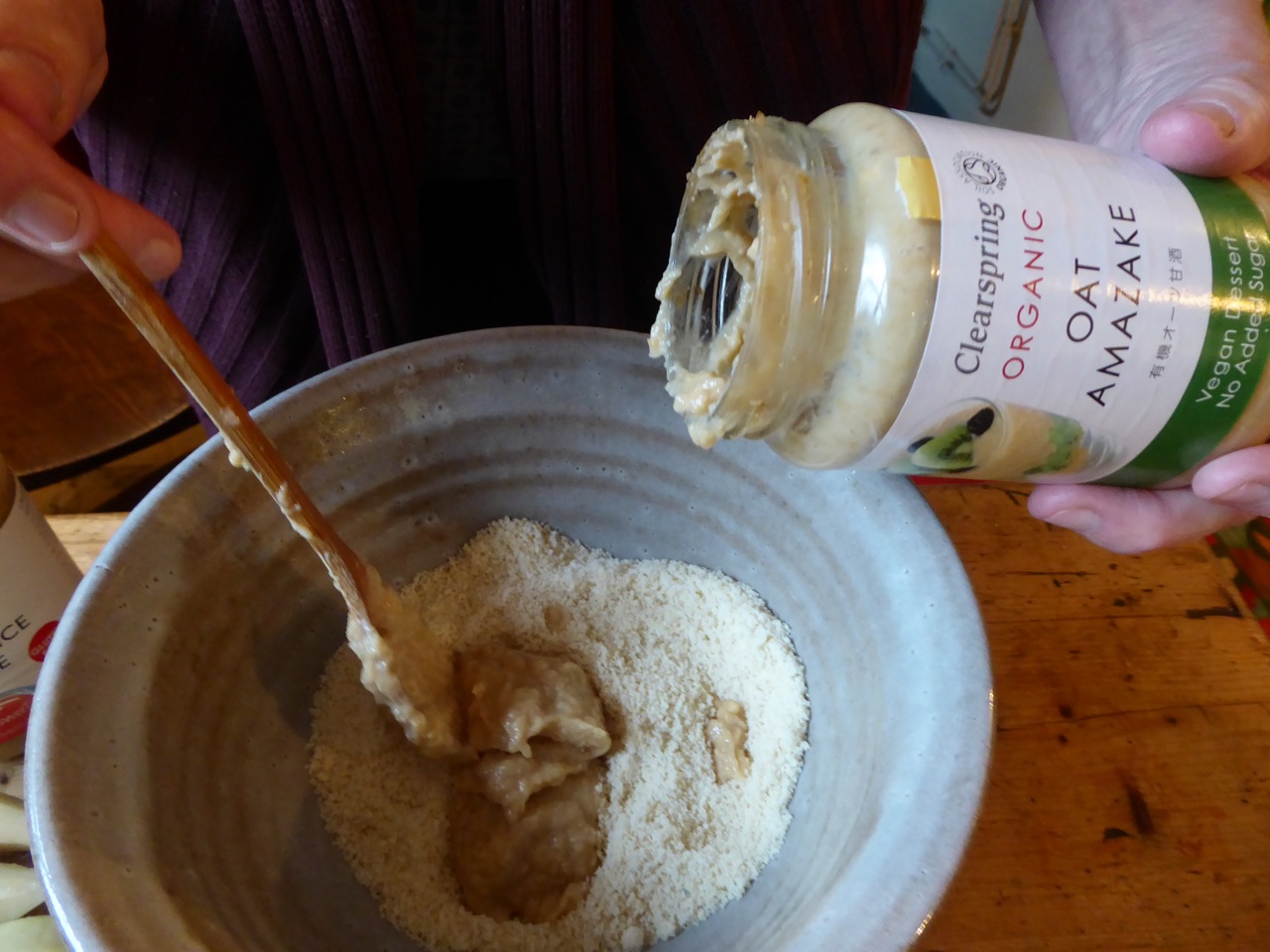
Clearspring contracts amazake product with its producers, to use the same time-honoured traditional methods that are used in all of their Japanese products, to create, not just brown rice amazake, but also millet amazake and a version made with oats. All are versatile and tasty, and all are made using yellow koji, Aspergillus oryzae, the same as used in sake making. This type of koji is very sensitive to temperature, demanding constant attention and a carefully controlled atmosphere, as we know from our sake studies.
Such innovation is another reason for Clearspring’s success: without ever deviating from their core principles, they push beyond the boundaries of Japanese foods. All the goodness of koji-based fermented foods is found in their millet and oat (and brown rice) amazake without compromising on quality and taste, and integrity. As all sake-lovers know, KOJI is the magic ingredient that forms the basis of many quintessential Japanese tastes: obviously sake but also miso, whole soya shoyu and tamari soya sauces, mirin and rice vinegar. We’ll be looking at some of these other products in future blogs.
Uses
Recipe below by Shirley Booth
Photo courtesy of Christine Booth
Although I have mentioned amazake being served warm in the winter, in fact it is also a popular drink in summer in Japan, served chilled, as it said to combat the effects of the enervating summer heat, which the Japanese call natsubare. And it’s so low in (almost devoid of) alcohol that it is popularly served at the Girls Festival, Hina Matsuri, on 3rd March. Like other fermented foods, its ability to boost gut health is now being recognised; and it has recently seen a resurgence in popularity, along with other traditional foods, as younger Japanese begin to appreciate the value of Japan’s unique and health-giving food traditions.
As well as a drink, amazake can be used in western style cooking. If you want to cut down on sugar, then try the natural sweetness of amazake in desserts, jellies and baking. It makes wonderfully creamy puddings, and fabulous ice-cream, useful for people who can’t or don’t drink dairy. It’s especially appropriate in January, when many are joining the throngs of the ‘Veganuary’ movement and avoiding animal products.
However, I must add that, mixed with salty miso, it makes a fine marinade for fish and meat. It can even be used in salad dressings – mixed with olive oil, a little sesame oil if desired, a dash of miso and rice vinegar. In fact, whether you are a meat eater or a vegan, amazake, high in B vitamins, digestive-boosting enzymes and flavour-enhancing amino acids, makes a delicious addition to your pantry.
Koji is a truly magical ingredient, as we will discover in future postings covering other fermented foods and Japanese traditions. Definitely something to thank the gods for.
by Shirley Booth

Recipe for Amazake Macaroons
A very quick and simple recipe, adapted from Jan and John Belleme’s Cooking
with Japanese Foods.
Ingredients:
140g/5 oz/ ½ cup amazake
45g/1 ½ oz/½ cup desiccated coconut
1 ½ tablespoons ground almonds
½ teaspoon sesame seeds
½ teaspoon tahini
1 tablespoon maple syrup
½ tablespoon plain flour
few drops almond extract
pinch salt
Heat the oven to 180°C (Gas mark 4, 350°F).
In a bowl, mix all the ingredients together, making sure they are well combined. Grease or line a baking sheet, and drop heaped teaspoonfuls of the mixture onto it. You should get about a dozen.
Cook for 10-15 minutes, until golden on top and underneath. They will still be fairly soft when you take them out, so don’t worry. Leave to cool before eating.
 British Sake Association 英国日本酒協会